

Music really is everywhere. Today as I stepped out of Haggerston station on my way to visit a school, I could hear piano music. It turned out that the mobile coffee stall right outside plays classical music as staff serve commuters and the music echoes through the station. Later as I had coffee with a friend visiting from America we were talking about the American Band model and how the university where he works has a band of over 150 students. Many of them ‘take band’ in school, they continue at university and so a tradition is established and the fact that the band plays at all the sports fixtures means it’s firmly embedded in the culture of the establishment.
As we talked, loud music was playing in the cafe, this time contemporary urban music setting the tone for a central London coffee bar. As we looked out of the window we observed how many people walking past were wearing headphones. Train carriages full of commuters are pretty quiet these days as we lose ourselves in our own world of personalised sound that’s delivered straight to our ears via our headphones. Talking last week to a 6th form student about how he uses digital platforms to support his music making, he said that he often uses the recommendations that pop up on Spotify, You Tube or Sound Cloud and he follows these through to discover more and more new sounds. Music really is everywhere and it’s more accessible than ever.
But there’s one place where you don’t hear a lot of music.
I am talking generally here and my focus is on secondary schools so apologies to schools that do play music in corridors or embed it into school life. And judging by how often my primary-aged children come home singing, I know they are making music at various point across the week. But my experience of secondary schools has been very different.
It’s common in most schools for headphones to be banned, students are very creative at hiding them but there’s often a tell-tale white lead tucked under their collar or hanging from their sleeve as they use music to challenge school rules. In secondary schools, it’s rare to hear music played in assembly or in the corridors or canteen at break time unless somebody happens to be practicing in a public space. But mostly this is confined to the music department where it seems the sole responsibility for the music education of our students lies.
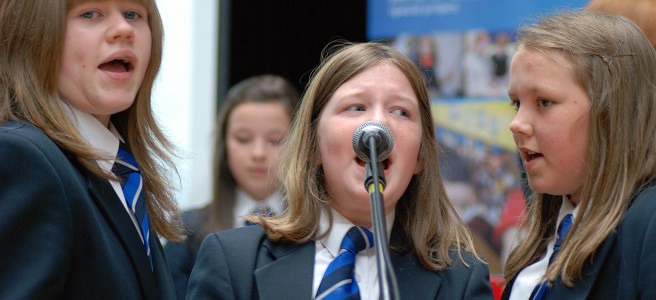
Wouldn’t it be amazing if, just like in real life, schools were open to music coming out of the music department and spreading across the school? if just like literacy, numeracy and more, cultural and arts education became the responsibility of everyone. Could we bring music into lessons and assemblies, building on the strong tradition of primary school music assemblies, singing assemblies and more? If primary teachers are expected to be able to deliver some form of music learning despite limited training and support, is there any reason why secondary teachers can’t do the same? Break time busking, music in the canteen, samba bands or taiko drummers at sports fixtures-music could really bring a school to life!
But that’s not what the #mufuchat question is asking. What is the place of classical music in the classroom? Is classical music the main genre through which music should be taught? Our exams system certainly seems to support this view. Taking GCSE and A Level music is a heck of a lot easier if you’ve had a private instrumental lesson or two! And westernising other musics in order to mark understanding of them (can you hear dynamics in this piece of gamelan music anyone?) is another thing that I’m not sure we have got right yet.
So when I think about the debate about which music should be taught in schools and how, I keep coming back to the same questions, which as usual I don’t have all the answers to!
- Is it really possible to replicate the experience of a one to one instrumental lesson where you can learn repertoire, theory, technique and relevant notations with 30 students and a few keyboards or computers? Where is the classroom pedagogy for teaching music and are different pedagogies, approaches and teachers needed for music of different genres? Who decides on the content, the approach and how do we know it’s any good?
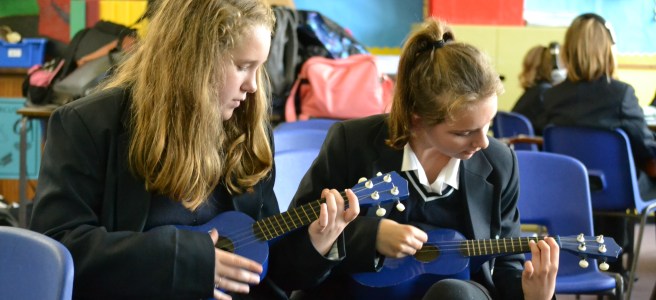
- How important is authenticity? I remember playing Pachelbel’s Canon to a class as they came in and heard an excited voice ask “Woah Miss are we going to play violins?” Well I didn’t have any violins and if I had I didn’t have the knowledge or skills to teach 30 year 8s how to play that piece on them in a classroom setting. We explored it vocally and with ipads. We unpicked how the melodies were constructed and knitted together, but it didn’t feel very authentic to me. I felt that their experience of the music had been a bit one-dimensional and I felt really guilty when I saw that child’s face fall when I said we wouldn’t be playing violins (but if his parents wanted to pay, he could have some lessons).
- What about progression? My daughter did a year of First Access brass in year 5. At the end she could get a few notes from a trombone and performed with the class at an assembly. But she didn’t know how to hold it properly and without some serious work she wouldn’t have progressed much further because she simply didn’t have the technique to produce more sounds. if I’m being honest, the performance at the end of the year wasn’t great and I reckon that time and money could have been spent a bit more sustainably elsewhere, perhaps on training for classroom teachers on how to link music to topic work or on some instruments that the children were likely to find in their secondary school.
- What about the reality? I’m talking secondary here. One hour each week, if we are lucky for three years. What is a realistic expectation, bearing in mind the diversity of experiences year 7 will have had in primary school before they get to secondary school? Can we ever expect to replicate those years of one to one instrumental lessons in these circumstances? Is theory, notation, instrumental skills to a level required to take A level music ever really attainable just in the classroom?
So I keep coming back to this blog that I wrote last year about breadth vs depth.
And does classical music belong in the classroom? Of course it does. But not just in the music classroom.
And I don’t feel it’s the responsibility of music teachers to bring on the next generation of classical musicians or listeners. I think music teachers need to open minds, facilitate the necessary skills and understanding to appreciate that music is music, you’ll like some, you won’t like others and that’s OK. How they choose to do this is up to them and if they are successful then pretty soon music will spill out of the music department and wash through the whole school and who knows what might happen next? Maybe some of those commuters with their headphones on are listening to Bach.





 Anna Gower