Confident Kitt

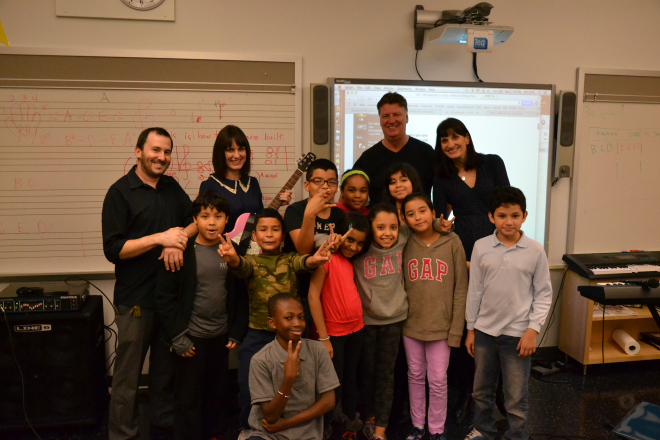
My second school visit this week was to Wymondham to visit Musical Futures Teacher Kitt. I was looking forward to seeing how he’s been getting on in his first Head of Music role. Kitt spent his second placement at Monks Walk and he has always been committed to embedding Musical Futures approaches, pedagogy and ethos into his teaching, giving it a personal twist to suit his own teaching style and musical values.

In both schools I visited this week, I was impressed not just with the engagement of the classes we watched but also the consistency of expectations and musical competency the students showed. They all participated, performed, shared, played informally to each other, talked about the work and stayed on task. For the majority of the lesson they were engaged in musical activity whether this was warm ups, rehearsing in groups or listening to each other. There was no written work in either lesson, no painful Q and A about the elements of music, however there was clear musical progress made and no question at all that they were learning-I could feel it, see it, hear it. It was in the conversations between the students during group work, the nodding of heads in time to the pulse, recognisable musical outcomes, ensembles coming together.

This week I saw Musical Futures teachers with a very clear understanding of what they were teaching, how they wanted to facilitate learning and why this made sense in the context of their personal musical values, their departments and tailored to suit the demographic of their students. But I also saw how embedded Musical Futures is into every year group, it’s definitely not a “MF-style 6 week rock and pop project” in these schools!

In just 5 weeks at Wymondham, Kitt has gone into his new role with a clear vision. Desks have gone, new equipment prioritised, ordered and set up, other staff supported to bring in MF approaches with all year groups.

This is what we have been looking for

But I was most impressed by what happened at the end of the day. MF Australia director Ken and I delivered a practical session after school to 6 local primary school music co-ordinators, a music hub representative, a woodwind teacher from the school who stayed unpaid because she was interested and 2 6th form girls who thought they might like to be primary school teachers.

We worked through a couple of the Musical Futures: Just Play resources and at the end discussion started about how this group could make Just Play possible for their schools. What really seemed to resonate with the group was that because JP is scaffolded for generalist teachers it has the potential to be sustainable, for the primary children in feeder schools to then progress through to an established and secure Musical Futures experience that really does build on what they can already do and have learned. Imagine what impact a shared cross-phase approach or pedagogy as opposed to a transfer of information between year 6-7 could have.

Credit to Kitt for pulling this group together and generating such interest in only 5 weeks in the job and for engaging his classes impressively quickly in a new approach, so different from what they were doing before.

I love the idea of local clusters of schools coming together to design, create, drive and sustain an Musical Futures cross-phase approach that works for them. I’m hoping that I’ll be back in Norfolk soon to work with teachers who are doing it for themselves.

Fabulous Fiona

With the release of yet another report that outlines the problems with music education in England, I still feel we aren’t hearing enough about how we could be addressing them. I’ve asked in a previous post about who might be able to help teachers to find some solutions, but as yet I don’t think we are much closer to solving this.

In the next few weeks I’m visiting Musical Futures schools across the UK and I’m interested in what teachers are doing at the chalk face in response to some of the challenges they are facing.

This week, my colleague Ken from Musical Futures Australia and I drove out to Norfolk so visit Fiona. 15 years into her job at Flegg High School, she has built a vibrant and musical department. However being unable to recruit a part time member of staff and increasing financial constraints means that she has found herself alone in the department.

Fiona is pretty honest about the challenges that frustrate many music teachers at this time. But she has found an answer. It’s her. She teaches every lesson (except where they are timetabled together when a cover supervisor helps as she goes between a GCSE and Btec class), she runs all the extra curricular groups including those which build on work done in lessons-the year 7 and 8 music clubs, choir, ensembles and more. A decline in the numbers of primary children learning traditional instruments hasn’t stopped her supporting a team of visiting instrumental teachers and concerts and performances continue as usual.

But as Ken pointed out, this just doesn’t seem fair.

So to all the Fabulous Fionas out there who recognise that unless they step up and do more than ever before, music will be at risk in their schools, thank you. The musical opportunities you bring to your students just couldn’t happen without you.

Musical Futures: Just Play-the story so far

Musical Futures: Just play is such an interesting project to be involved in. I have met some really inspiring primary teachers here and overseas who may not have much musical experience or instrumental skills but who recognise the value of making music with their classes.

musicalfuturesjustplay's avatarMusical Futures: Just Play

Posted by Anna-MF UK

Back in October 2014, Abi and Anna from MF UK and Ken from MF Australia visited New York to have a look at the work of Little Kids Rock, a non-profit organisation committed to opening up musical opportunities for primary aged children in schools through their Modern Band Programme.

2014-10-23_03-00-10 Abi, Anna and Ken with pupils engaged in a little Kids Rock after school inititive, NYC Oct 2014

Following the visit, we looked at the overlaps between our approaches and in particular how running an intensive musical training workshop for teachers could help primary generalists to feel confident and competent to start to use Just Play with their classes.

“The teacher felt the critical thing was that she had gone through the process alongside the pupils, could see it through their eyes, understand what is difficult, embarrassing, made her nervous etc so she felt she could…

View original post 330 more words

Do you have to be a musician to teach music

As Musical Futures launches their “Just Play” pilots designed to be led by generalist primary music teachers (no musical experience required!) in Australia and Scotland in the next 2 weeks, I’m revisiting a debate that always raises controversy and rightly so!

mrsgowersclasses's avatarmrsgowersclasses

Emile Holba

And do you have to be musical to teach music. Is there a difference?

I want to try and clarify my stance on this by looking at some of the things I have taught and seen others teach over the years and in particular how it has been taught.

Fresh from Uni I was armed with a music degree and having had plenty of opportunities to perform in a variety of musical contexts on several instruments I certainly thought of myself as a musician at the time. However, I don’t think, looking back, that I was particularly musical. As part of my PGCE we did some improvising and without notation, I froze. I certainly didn’t consider myself to be any kind of composer and singing without the comfort of the formality of a choir with a conductor and the music was my least favourite activity. I shied away from conducting…

View original post 812 more words